

Originally published by WallStreetBets @wallstreetbets on X.
View original article
· View original post
· 2026-04-30T20:51:55.000Z
“TAO 2026 = ETH 2016 = BTC 2013.” — Rob Greer (@rob_svrn), partner at @stillcorecap, one of the largest TAO funds.
Bitcoin miners generated $17.2 billion in revenue in 2025. To earn it, they consumed over 175 terawatt-hours of electricity annually, roughly equivalent to the entire power consumption of Poland.
The computation itself produces nothing beyond solving complex mathematical puzzles to validate transactions and secure the network. No scientific output, no intelligence, no product. The energy is real, the cost is real, but the output ends at “transaction confirmed.”
@bittensor looked at that model and asked a simple question: what if the mining solved real problems?
Instead of burning compute on arbitrary math, Bittensor’s network pays miners such as data scientists, ML engineers, and AI researchers to produce machine intelligence. Instead of confirming transactions, the huge GPU power is routed to actual AI products that people use. Some even rival centralised counterparts across industries.
Validators on the network evaluate the quality of those outputs using an algorithm called Yuma Consensus, and TAO rewards flow to whoever is producing the most valuable work.
The network then organizes this work into specialized units called subnets, each focused on a specific task. 128+ subnets are live now, spanning across trading signals, language model training, computer vision, code generation, and financial forecasting. Some of these subnets are already generating millions in revenue and partnering with companies like Intel and PwC.
The best minds in the ecosystem are already positioned in TAO:
Rob Greer is already targeting a $1 trillion TAO market cap by 2030.
@jason, the man who turned $25,000 into $100 million on Uber, put close to a million dollars of his own money into TAO and is calling for a 200x return in 5 to 10 years.
@BarrySilbert, founder of DCG, the firm that backed Bitcoin, Ethereum, Zcash, and @coinbase early, has launched an entire subsidiary called Yuma dedicated exclusively to accelerating Bittensor.
Subnets are pulling in talent from @OpenAI, @GoogleDeepMind, and other top AI labs.
I sincerely believe TAO is the Bitcoin of AI and will follow the same pattern. And this is my thesis for it.
Why now?
A lot has happened in the Bittensor ecosystem recently. @tplr_ai being the biggest.
For the uninitiated, Templar (SN3) was the crown jewel of the ecosystem. The parent company, @covenant_ai completed a 72-billion-parameter model trained by 70+ contributors on home GPUs, no data center required.
On the back of this development, TAO surged, almost 90%. The ecosystem hit a combined valuation of $1.5 billion. Then in April, the founder Sam Dare dumped 37,000 TAO, roughly $10 million. The community started questioning the very fundamentals of TAO, even when Const, the co-founder of Bittensor took immediate steps to fix it.
But most people are looking at the wrong thing. ALL of the major ecosystems have had black swan events. Solana came back from the toughest setbacks of the entire industry, FTX, and now has a die-hard community. I could go on about Ethereum’s DAO hack, but let’s leave that for another article.
The point is, every maturing ecosystem will have bad actors. It’s how the founders and community choose to respond to it and improve the ecosystem. TAO’s response has been quite strong across the board, with the introduction of Locked Stake to strengthen subnet ownership and decentralization.
All of this makes me more bullish on TAO than ever. On top of that, TAO’s supply side is about to get very interesting.
TAO’s tokenomics mirror Bitcoin almost exactly.
21 million TAO tokens, a fixed supply, no pre-mine, no VC allocation.
Bitcoin’s first halving happened on November 28, 2012. The price that day was $12. One year later, it was over $1000. An 83x return, which no one expected.
TAO’s first halving happened on December 14, 2025. We’re 5 months in, and TAO’s already shaping up to have its Bitcoin moment for 2026 and beyond.
The Institutions And Smart Money Are Watching TAO
The best way to get a macro view of an ecosystem is to understand how smart money is viewing it. I’ve talked to multiple high-profile investors and people who were early to BTC, Ethereum, and @Uber, all have either invested in or have TAO on their radar.
Let me start with someone I have a lot of respect for. The legendary @BarrySilbert. The man built @DCGco, the firm behind @Grayscale. Grayscale holds TAO in their Decentralised AI Fund and has filed with the SEC to convert the GTAO Trust into a spot ETF. This is the same path that preceded Bitcoin’s spot ETF approval. And now, DCG has launched an entire subsidiary called @YumaGroup, dedicated exclusively to accelerating Bittensor adoption.
In my recent visit to the DCG summit and meeting with Barry, he called TAO a generational opportunity. Barry and Yuma have been a massive force in furthering TAO, and I’m grateful for what they have done for this space.
Now let’s talk about Stillcore Capital. They’re one of the most important funds in the TAO ecosystem, having invested in almost all the top subnets. Stillcore Capital is led by @rob_svrn, @markjeffrey, and @Jason, who I mentioned earlier as some of the biggest TAO supporters. Their goal is to own 1% of all TAO in existence.
@markjeffrey literally wrote books on Bitcoin and is now deploying capital into what he calls the next foundational layer of the internet. Mark’s thesis is that once the first subnet crosses $1 billion in market cap, root stakers will rush into subnets, and less than 20% of all TAO is currently staked into subnets. That migration alone, with no new TAO purchased, could 3-4x subnet valuations.
Unsupervised Capital, another big fund in the space, projects that TAO will hit $4,800 by Dec 2027, a 19x increase from today. Their bull case analysis says TAO will reach $10,800.
This analysis was done before Covenant-72B moment, before Jensen Huang mentioned Bittensor, and before PwC signed a formal alliance with a Bittensor subnet.
Arthur Hayes, co-founder of BitMEX and one of the most closely followed macro thinkers in crypto, said he believes Bitcoin’s biggest risk isn’t the Iran war, it’s AI. He has also voiced that AI-focused crypto tokens will outperform Ethereum by 2030.
My Picks for the TAO ecosystem
Targon (SN4): The Private Compute Infra Intel Trusts

@TargonCompute is the true unicorn of the TAO ecosystem.
Essentially, it is the decentralised, cost-effective, and more private alternative to AWS and Azure for running AI.
The biggest thing holding back enterprises from adopting decentralised compute has always been trust. Running sensitive AI workloads on hardware you don’t control raises security risks, while managing them in-house drives up costs.
Targon Virtual Machine (TVM) solves this problem through encryption and hardware-backed protection, allowing developers to run trusted workloads on untrusted hosts. Hardware operators can’t access your data, your model weights, or what you’re running.
Targon OS, expected to launch soon, provides the operating layer for secure computation. It lets millions of consumer GPUs, like 4090s and 3090s, that can’t use TVM today, securely join the Targon network. These GPUs will be available at a separate trust tier and lower pricing, through the same API.
On the demand side, their inference layer already powers Dippy AI’s backend, a platform with over 8 million users.
All of this was built by @0xcarro and @jameswoodmanv, both former members of the @opentensor, the organisation that built and launched Bittensor. Robert Myers was actually among the very first miners on Bittensor, one of the first three people ever in the Bittensor Discord. James Woodman is an incredible eco leader with prior experience at GSR, one of the most respected quantitative trading firms in crypto.
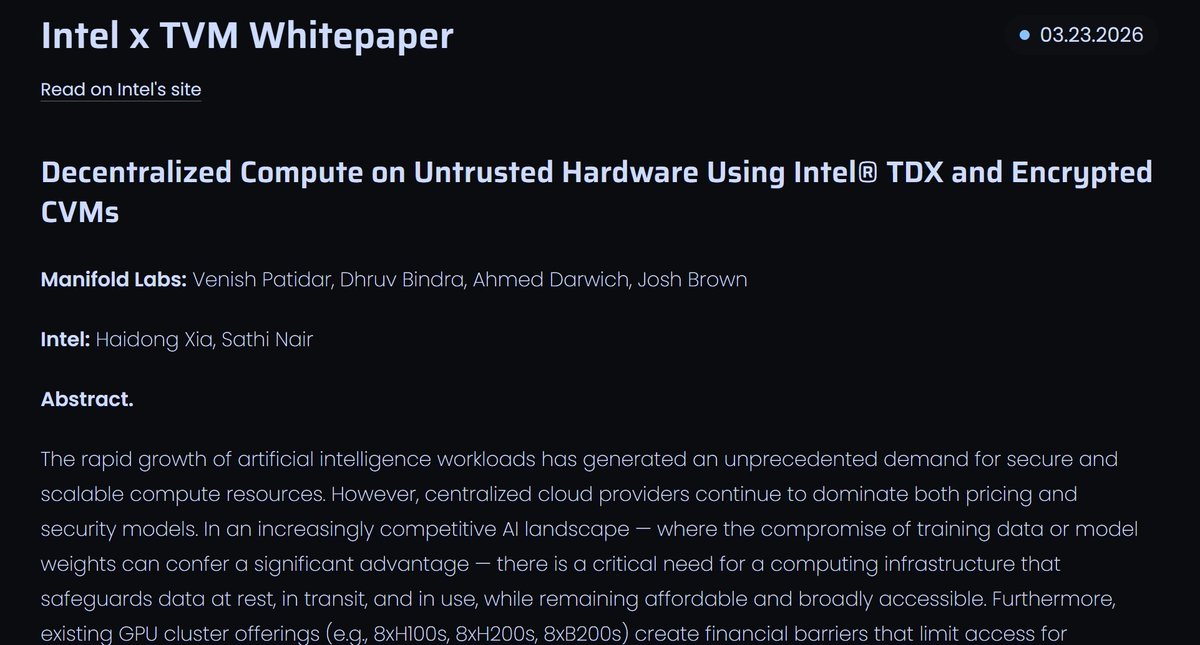
What really caught my attention was this paper Targon (aka Manifold labs) co-authored with @intel in March earlier this year. Intel does not casually co-author technical papers with crypto projects, and this is a big signal of upcoming wider adoption.
I fully expect Targon to announce more enterprise partnerships in the months ahead.
Vanta (SN8): The Prop Firm With a 100% Profit Split

The global prop firm industry is worth nearly $20B. But traditional prop firms are extractive by nature. Traders pay anywhere from $50 to over $1,000 just for the evaluation, get stuck in endless reset loops, and when they finally pass, they only receive 50-80% of their profits. FTMO, one of the leading prop firms, closed over 329 million in revenue for 2024, but traders didn’t see much of it.
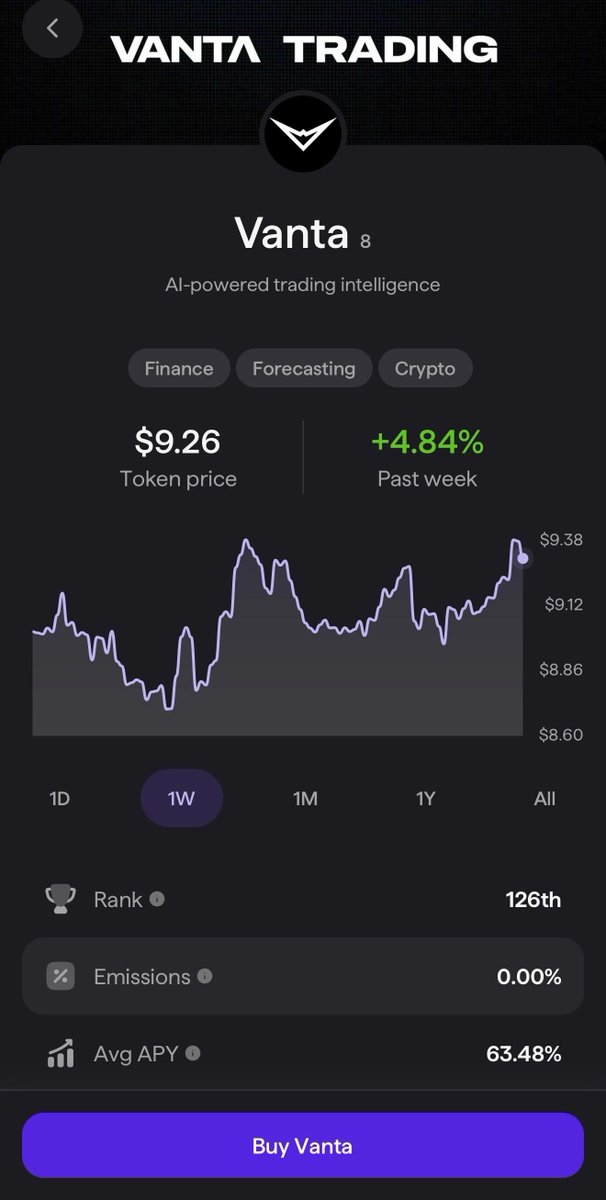
From everything I’ve read about @VantaTrading, they are well-positioned to take over this entire industry.
Vanta brings prop firms to TAO, with every single metric verifiable on-chain and on their dashboard. With Vanta trading, traders pass a single evaluation and keep 100% of their profits. They also have a Hyperliquid version called Hyperscaled, built natively to help traders on HL access more capital.
Validators on SN8 assess trader performance onchain, enforce rules, and determine reward eligibility in a transparent and trustless way.
Every evaluation purchase drives real economic activity into the subnet. Fees are used to buy back alpha tokens, creating a direct flywheel between product revenue and token value. Last month, Vanta became net profitable in terms of revenue generated from fees vs the miner emissions on their network.
Moreover, they don’t rely on evaluation fees as their only revenue stream. Vanta A-books their best traders via their CFTC-compliant platform Glitch to generate profits. They are up 8% in returns this year against 1% drawdown via their index model across the best traders on the network.
Chutes (SN64): The Decentralised AWS, With No CEO

Built by @rayon_labs, @chutes_ai is a serverless AI compute platform that allows developers to deploy, scale, and run any open-source AI model in production at significantly lower cost than AWS.
Here are some early adoption metrics:
- #1 open source provider on OpenRouter
- Over 9.1 trillion tokens processed
RESI (SN46): Intelligence Hub for the $600T Real Estate Market
The real estate market is one of the largest asset classes on earth, valued at over $600 trillion globally. And it is still running on the same technology for decades (much like banks).
The US doesn’t even have a unified real estate database. There are over 580 separate MLS systems, most running on legacy software with frequent outages and data that lags hours or days behind reality. Zillow pulls from these fragmented sources and adds its own estimates, causing inaccurate valuations that mislead consumers. The entire stack is broken.
That’s where @resilabsai comes in.
RESI (Subnet 46 on Bittensor) is an institutional-grade intelligence layer for real estate. Their models deliver state-of-the-art remote appraisals with over 98% accuracy. They were recently featured on “This Week in Startups”, worth watching:
Since their launch:
- 1000+ appraisals done in the first week
- Nationwide lender partnership signed
- Strategic investment secured from Stillcore Capital
RESI is a low-market-cap subnet with a trillion-dollar addressable market and a team that is shipping. I consider RESI one of the highest-conviction opportunities in the entire TAO eco.
Affine (SN120): Built by the Man Who Started It All
@affine_io is led by Jacob Steeves (aka Const), the co-founder of Bittensor itself. The man who wrote the original TAO whitepaper, built Yuma Consensus, and designed the subnet architecture is now building his own subnet inside the ecosystem he created. That alone is a bullish enough thesis.
Affine runs continuous evaluations to identify and fine-tune the best open-source reasoning models. It does not host its own models, instead leverages Chutes (SN64) for model hosting, creating a direct value loop between the two subnets. Every evaluation it runs produces open-source intelligence that improves the broader Bittensor ecosystem.
Const’s involvement makes Affine one of the most credible subnets on the network.
TAO.com: The access layer for TAO

So far I’ve covered the subnets I’m most bullish on. But there’s another side to this, the infrastructure. The picks and shovels that actually let people access all of these innovations.
TAO.com is the Apple iOS moment for the Bittensor ecosystem. It’s the easiest, most intuitive way to buy, hold, stake TAO, and swap into subnet alpha tokens, all from a mobile device.
If you’re exploring the TAO ecosystem, I heavily recommend using @TAO_dot_com as your main wallet. It takes a couple of clicks to buy your preferred alpha tokens on the TAO.com wallet.
In addition to being the best TAO wallet, they’re actually one of the three multisig key holders that can make ecosystem-level changes to the Bittensor network. They were one of the largest early miners on the protocol and a foundational piece of infrastructure.
Android support is expected to launch soon, giving them access to billions of global users. If you believe in the Bittensor thesis, TAO.com is how most people will eventually access it.
Honourable Mentions
1. Score (SN44):
@webuildscore is Bittensor’s computer vision subnet, and it just became the first subnet in the network’s history to partner with a Big Four professional services firm.
PwC France signed a formal alliance to distribute Score’s Manako product to enterprise clients across retail, manufacturing, logistics, energy, and infrastructure.
Jean-Thomas Ledoré, Strategy Partner at PwC France, said:
“Physical AI is rapidly moving from emerging technology to an operational necessity. By partnering with Manako and leveraging Score decentralized AI infrastructure on Bittensor blockchain, we enable our clients to move faster beyond observation and experimentation, and toward real‑world execution, turning physical environments into systems that drive decisions, actions, and scalable value creation.”
Score also won the Bittensor track at Paris Blockchain Week the same morning.
The PwC network does $60 billion annually across 137 countries. That is now a distribution channel for a Bittensor subnet.
2. Oro (SN15):
Co-founded by @shardiban and @ironseth_s, Oro is building and benchmarking the world’s best autonomous AI shopping agents through fully open, incentivised competition. @oroagents is where AI learns to shop.
In just a few weeks, 45 Oro agents have outperformed GPT 5.4 at one of the hardest online shopping evals to date. The subnet runs a daily race where the top agent earns emissions in real time, generating ~60K agent trajectories per day.
The Bigger Picture
Today, TAO trades at roughly a $3 billion+ market cap. OpenAI raised thirteen times that amount in a single round and is targeting a trillion-dollar IPO. The subnets detailed above are generating real revenue, partnering with enterprise players like Intel and PwC, and serving millions of users. TAO subnets are quietly building the entire decentralized AI economy.
The gap between what TAO has built and how it is currently priced is, in my view, one of the most asymmetric opportunities in crypto.
Every major technology shift in history started centralised, then open source tech stack took over. AI is following the same pattern. Closed labs have billions in capital, open-source communities have millions of developers. History tells us which side generally wins.
Bitcoin was money. Ethereum was apps. TAO is intelligence.
And we are still early.


