

Originally published by KawzInvests 🦑 @KawzInvests on X.
View original article
· View original post
· 2026-02-26T20:19:29.000Z

The Heavy, Hot Electron vs. The Massless Photon
For over fifty years, the technology industry has relied on a single subatomic particle to perform and transport calculations: the electron. But electrons have mass, they carry a charge, and when you push billions of them through microscopic copper wires, they crash into the atomic lattice, generating massive amounts of heat. Today, the artificial intelligence industry has hit the “Copper Wall.” We can no longer move electrons fast enough, or cool them down quickly enough, to feed million-GPU AI clusters without melting the power grid.
To solve this physical bottleneck, the industry is abandoning the electron for the transport of data and turning to the photon. Here is the fundamental physics report on how photonics works, how light moves through solid matter, and why it is the ultimate computing highway.

1. The True Nature of Light: Waves and Wavicles
To understand photonics, we must first understand what light actually is. Classical physics describes light as a continuous electromagnetic wave an oscillating disturbance of electric and magnetic fields. However, modern Quantum Electrodynamics reveals that light is fundamentally quantized. It is absorbed and emitted in tiny, discrete bursts of energy called photons.
Photons are massless, chargeless elementary particles that exist only at the speed of light (c). While we can measure the macroscopic wave-like behavior of light (like interference and diffraction), on a submicroscopic level, a beam of light is actually a dense, statistical barrage of these independent photons.

2. The Illusion of Slowing Down: The Index of Refraction
In a vacuum, photons travel unimpeded at exactly c (roughly 300,000 km/s). But when light enters a physical medium like the silicon waveguides of a new NVIDIA optical chip or the glass core of an optical fiber it appears to slow down.
In reality, photons never slow down; they only ever travel at c. The apparent reduction in speed is a macroscopic illusion caused by the complex physics of atomic scattering:
The Scattering Engine: When an electromagnetic light wave sweeps through a dense material like silicon, its electric field drives the negatively charged electron clouds of the atoms into oscillation.
Re-emission: These vibrating electron clouds act like miniature microscopic antennas, instantly absorbing and re-emitting (scattering) new wavelets of light.
The Phase Lag: Because of the physics of these driven atomic oscillators, the newly scattered wavelets are slightly out-of-phase they lag just a tiny bit behind the primary incoming wave.
The Resultant Wave: When the primary wave and the billions of slightly delayed secondary wavelets blend together (superpose), the resulting transmitted wavefront is held back. This continuous, cooperative process of scattering and phase retardation creates the macroscopic illusion that the light beam is moving slower, which dictates the material’s Index of Refraction.
3. The Superpower of Light: Photons Don’t Crash
The greatest physical limitation of the “Copper Era” is crosstalk. Because electrons carry a negative charge, their electromagnetic fields interact. If you place unshielded high-speed copper wires too close together, their signals will fatally interfere with one another.
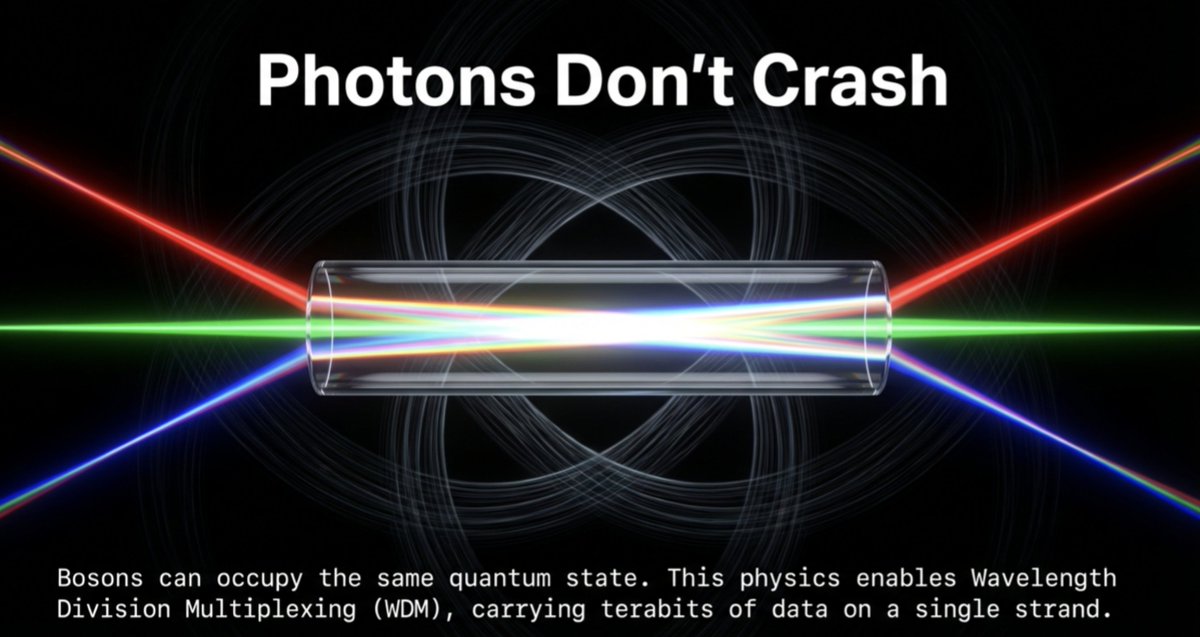
Photons, however, are a class of quantum particles known as bosons. Unlike electrons, photons generally do not interact with one another. Because of this, optical beams can pass directly through each other in free space or cross within an integrated silicon waveguide without suffering from any crosstalk or signal degradation.
This leads to the ultimate physics “hack” of the telecom and AI industries: Wavelength Division Multiplexing (WDM). Just as a glass prism separates white daylight into a rainbow of distinct colors (frequencies), engineers use microscopic silicon “reverse prisms” to combine hundreds of different frequencies of infrared lasers into a single beam. Because photons of different frequencies completely ignore one another, a single optical fiber the width of a human hair can carry hundreds of independent data highways simultaneously, pushing bandwidth into the trillions of bits per second.
3. How Light Actually Becomes Data (The Prism Effect)
Because photons don’t crash, the industry can leverage an incredible physics “hack” to bypass the limits of traditional copper wires. Here is the exact physical process of how data is encoded onto light and extracted at its destination:
Step 1: The “Dumb Lightbulb” (Generation): The process starts with a Continuous Wave (CW) laser. As the head of Marvell’s Cloud Optics division noted, a CW laser acts exactly like a “dumb lightbulb”. It emits a constant, steady beam of infrared light that carries absolutely no data.
Step 2: The Shutter (Modulation): This steady beam of light is fed into a microscopic silicon photonics chip, where it hits a component called a modulator. The modulator acts like an incredibly fast shutter, rapidly turning the light signal on and off. Advanced systems use a technique called Pulse Amplitude Modulation (PAM4), which modulates the light into four distinct amplitude levels. Because it uses four levels instead of just simple on/off binary, each flash of light carries two bits of data instead of one, effectively doubling the data rate.
Step 3: The Reverse Prism (Multiplexing): In order to send massive amounts of data, engineers use several lasers, each producing a slightly different infrared “color” (wavelength). Each color is modulated with its own independent data stream. A component called a Multiplexer (MUX) acts like a “reverse prism,” mixing these distinct, multi-colored signals into one single, unified beam of light that is shot down a single glass fiber. This is known as Wavelength Division Multiplexing (WDM).
Step 4: The Catching Prism (Demultiplexing): When this single beam reaches the other side of the data center, it enters a De-Multiplexer (DEMUX). Just as a standard glass prism physically bends and separates white light into a rainbow of distinct colors, the DEMUX physically separates the incoming beam back out into its distinct, individual wavelengths.
Step 5: Back to Electrons (Detection): Finally, each separated beam of blinking light is pointed at a photodetector. The photodetector absorbs the photons and translates the optical information back into tiny electrical currents. A Transimpedance Amplifier (TIA) then amplifies this faint current into a standard electrical voltage. The photons have officially been turned back into digital data that the computer’s logic chips can read.
4. The Frictionless Highway: Dissipationless Dynamics
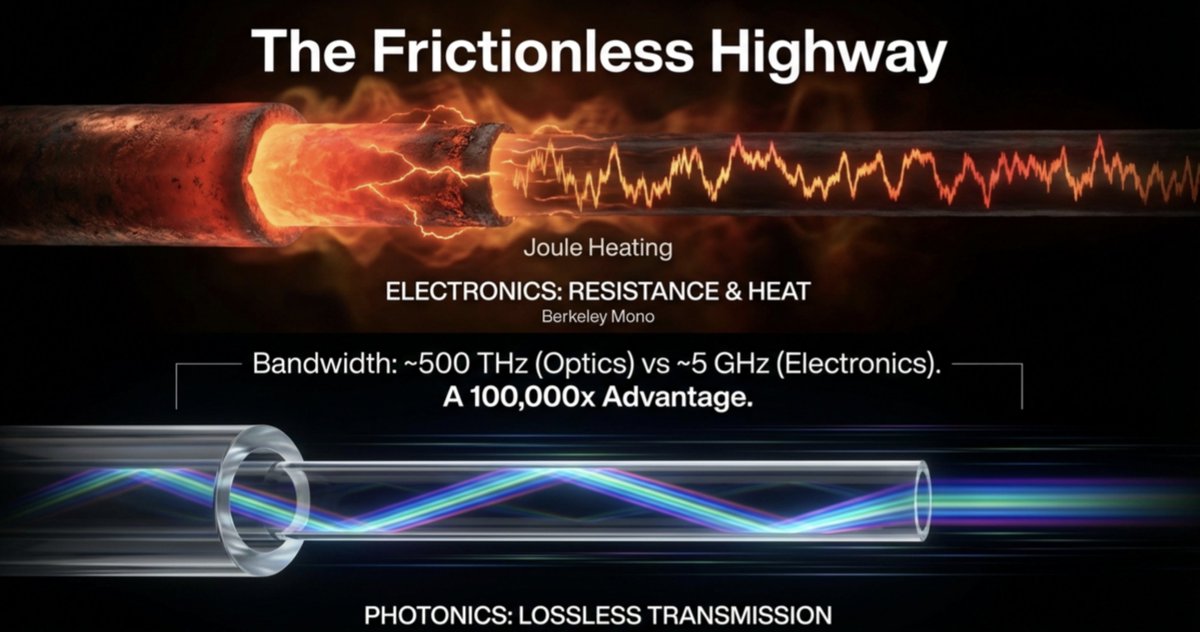
The reason AI data centers are facing a 435-megawatt power crisis is due to electrical resistance. When electricity is forced through copper, the electrons physically collide with the metal’s atomic lattice, violently losing energy in the form of resistive heat.
Photonics entirely bypasses this thermal density wall. Light can propagate through transparent optical media (like silicon nitride, lithium niobate, or ultra-pure fused silica) with nearly zero energy loss. When optical energy is lost in these waveguides, it is typically because a photon is scattered out of the guide, rather than being absorbed and converted into chip-melting heat. This nearly dissipationless dynamics allows data to move across an AI data center using 3.5x to 5x less power than traditional copper connections.
Furthermore, because light operates at incredibly high frequencies (optical frequencies are around 500 THz, compared to a standard electronic clock speed of around 5 GHz), photonics provides roughly 100,000 times the intrinsic bandwidth of an electronic system.
Conclusion For half a century, the semiconductor industry has conquered the physics of the electron, shrinking transistors to manipulate them for computation. But to move data, electrons are too heavy, too hot, and too prone to interference. By transitioning to Silicon Photonics, the industry is physically upgrading its infrastructure from the heavy, resistive friction of electricity to the massless, interference-free, light-speed physics of the photon.

