

Originally published by Peter H. Diamandis, MD @PeterDiamandis on X.
View original article
· View original post
· 2026-02-16T15:01:11.000Z
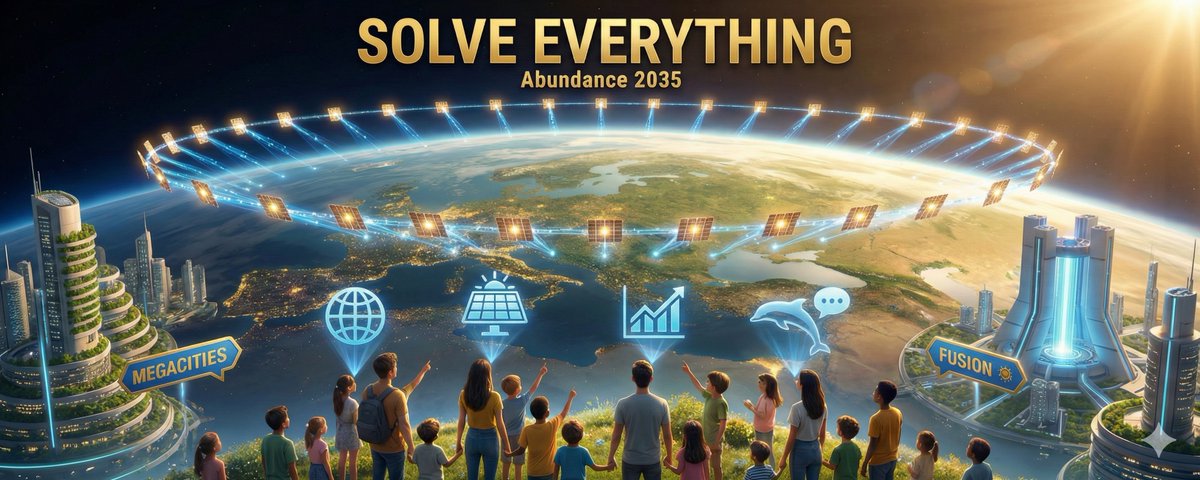
“Solve Everything” — The Roadmap to Abundance by 2035
This week, my co-author Dr. Alex Wissner-Gross and I unveiled something I believe will be as significant as Leopold Aschenbrenner’s “Situational Awareness” or Dario Amodei’s “Machines of Loving Grace.”
It’s called “Solve Everything.”
It’s a nine-chapter manifesto detailing how we can use artificial superintelligence to achieve post-scarcity Abundance by 2035 – but only if we make the right decisions in the next 18 months.
Read the full paper: www.SolveEverything.org
Let me break down why this matters and what you need to do.
NOTE: If the next 18 months will define the next century, where you spend them—and who you spend them with—matters. My Abundance Summit is where CEOs, entrepreneurs, and investors come to pick their Moonshot and build alongside the people shaping what comes next. In-person seats for the 2026 Summit next month are nearly sold out. Learn more and apply.
The 18-Month Window That Will Define a Century
We are living through the most consequential period in human history.
Not hyperbole. Not hype. Historical fact.
The decisions we make in the next 18 months—about how we direct artificial superintelligence, what problems we aim it at, and who controls the infrastructure—will lock in patterns that persist for decades, perhaps centuries.
Think about the QWERTY keyboard. Designed in the 1800s to prevent mechanical typewriter keys from jamming, it’s still the standard interface 150+ years later… long after the mechanical constraints that created it have disappeared. We’re stuck with QWERTY until the heat death of the universe.
Right now, we’re making similar decisions about the intelligence revolution. And unlike keyboards, these choices will shape everything from energy systems to governance to human purpose itself.
Technologies get locked in. As Alex noted during our Moonshots conversation, “We’re going to be stuck with decisions made in the next 18 months for far longer than we think.”
The Core Thesis: Cognition is Becoming a Commodity
Here’s the fundamental insight:
Intelligence is about to flow like oil.
GPUs are the new oil wells. Cognition is becoming a utility you can simply pour onto problems, and solutions flow out the other side.
But here’s the critical question: Where do we aim it?
Think of superintelligence as an explosive.
If you want an explosion to be productive (like a rocket engine thrusting you upward), rather than destructive (like a bomb), you have to shape the charge – direct the force through a nozzle toward a target.
Right now, we risk what Alex and I call the Muddle: bureaucracy, inefficiency, and rent-seeking consuming superintelligence on trivial problems.
Virtual girlfriends. Ad optimization. TikTok engagement loops. Bureaucratic paperwork. Regulatory capture.
This would be a civilizational tragedy.
We have the most powerful tool humanity has ever created—artificial superintelligence capable of solving our grandest challenges—and we could waste it on garbage.
Instead, we need to shape the charge and aim superintelligence at Moonshots that actually matter.
The War on Scarcity: Four Revolutions
To understand where we’re going, we need to understand where we’ve been.
Human history has been defined by a series of revolutions, each one a war on scarcity:
1. The Scientific Revolution (1600s)
– Enemy: Ignorance
– Weapon: The scientific method
– Result: Ability to understand and predict natural phenomena
2. The Industrial Revolution (1800s)
– Enemy: Muscle (physical labor scarcity)
– Weapon: The engine (steam, combustion)
– Result: Mechanization, mass production, economic transformation
3. The Digital Revolution (1960s-2000s)
– Enemy: Distance (information scarcity)
– Weapon: The bit (decoupling information from atoms)
– Result: Global communication, internet, software eats the world
4. The Intelligence Revolution (2020s-2030s)
– Enemy: Human attention (cognitive labor scarcity)
– Weapon: The token (artificial superintelligence)
– Result: Industrialization of cognition, bulk-solving entire domains
We are now in Revolution #4.
And unlike previous revolutions, this one will collapse the timeline from decades to years.
The Mechanics: How We Actually Solve Everything
“Solving” a domain doesn’t mean a lone genius figures it out.
It means we industrialize progress: we build systems that let millions of people (and AIs) solve entire categories of problems by simply pouring compute onto them.
What does it mean to “solve” a domain?
It means you get it to the point where you can scalably compute on it: pour more resources in, get more solutions out. Predictably. Repeatedly. At industrial scale.
We’re already seeing this happen:
· Math: Largely solved. AI can now prove theorems, discover new mathematics, verify proofs at scale.
· Coding: Solved. AI writes production-quality code faster and often better than humans.
· Physics (next 18 months): Igor Babuschkin (XAI co-founder) was “blown away” by Claude Opus 4.6’s physics capabilities this week. Domain collapse imminent.
· Chemistry, Biology, Materials Science (next 2-3 years): The wave is spreading.
AlphaFold 3 was the template.
It took protein structure determination—a problem that used to require a PhD student 5+ years of laborious bench work per protein—and solved it overnight for millions of proteins.
That’s domain collapse.
And it’s about to happen over and over again across science and engineering.
The Industrial Intelligence Stack: The Architecture of Solving Everything
To solve a domain at scale, you need seven layers (what we call the Industrial Intelligence Stack):
1. Purpose: The objective function. What problem are you solving?
2. Task Taxonomy: The map of the terrain. What are all the sub-problems?
3. Observability: Raw data from sensors and streams to measure progress.
4. Targeting System: Benchmarks and evals that shape the AI toward the goal. (This is the rocket nozzle that directs the explosion.)
5. Model Layer: The AI “brain” that generates solutions.
6. Actuation: Hands, APIs, robots that execute solutions in the real world.
7. Verification: Red-teaming, governance, and validation that solutions actually work.
The alpha for entrepreneurs:
The race isn’t about building the best AI model. Models are becoming commodities.
The race is about writing the best scorecard that everyone else is graded on.
Today’s healthcare system optimizes for “patients processed per hour.” That’s the benchmark.
What if the benchmark were “patients still healthy five years from now”?
The system would optimize for completely different outcomes.
Whoever writes the benchmark controls the game.
The 15 Moonshots: Where Do We Aim the Charge?
We lay out 15 “Giga-XPRIZEs”—humanity-scale challenges we can now tackle if we aim our superintelligence correctly:
Health & Longevity:
1. Extended human healthspan (120+ healthy years, longevity escape velocity by 2032)
2. Reversing aging (epigenetic reprogramming, cellular rejuvenation)
3. Printing human organs (end transplant waitlists)
Abundance & Resources:
4. Ending hunger (synthetic food systems, precision agriculture)
5. Fusion energy (unlimited clean power)
6. Disaster prediction and prevention (earthquakes, tsunamis, wildfires)
Knowledge & Consciousness:
7. AI-empowered education (personalized for every child on Earth)
8. Understanding consciousness (the hard problem solved)
9. High-bandwidth brain-computer interfaces (direct neural communication)
10. Mind uploading (digital immortality as Plan C)
Civilization & Exploration:
11. Multi-planetary species (Mars colonies, O’Neill cylinders, space habitats)
12. Orbital computing (Dyson swarm, space-based data centers)
13. Interspecies communication (talking to whales, dolphins, elephants, great apes)
Science & Engineering:
14. Solving physics (unified field theory, quantum gravity, theory of everything)
15. Post-scarcity economics (Universal High Income, Abundance for all)
These are no longer science fiction.
They are engineering problems solvable in the next 10 years – if we aim our compute correctly.
If we let the Muddle win, we waste the opportunity. If we shape the charge, we get Abundance by 2035.
Muddle vs. Machine: Two Futures
The Muddle:
Superintelligence exists, but it’s wasted:
· Bureaucrats use AI to generate more paperwork
· Regulators capture AI for rent-seeking
· Monopolies lock models behind paywalls
· Compute gets allocated to virtual girlfriends and ad optimization
· We measure inputs (hours worked) instead of outputs (problems solved)
Result: Stagnation. The social contract pixelates away. Civil unrest. Dystopia.
The Machine (Abundance):
Superintelligence is aimed at Moonshots:
· Energy becomes post-scarce (fusion, Dyson swarms)
· Food becomes post-scarce (synthetic biology, vertical farms)
· Health becomes post-scarce (longevity escape velocity, organ printing)
· Knowledge becomes post-scarce (AI tutors for every human)
· We measure outputs (verified outcomes) not inputs
Result: Abundance by 2035. Universal High Income. Human flourishing. Civilization-scale breakthroughs.
The choice is ours. But the window to choose is 18 months.
What You Can Do: Build the Rails
If you’re a CEO or Executive:
1. Digitize everything. Make all plans, reports, workflows AI-digestible.
2. Shift to outcome-based compensation. Pay for verified results, not hours.
3. Pick your Moonshot. Which of the 15 challenges can your organization tackle?
4. Build your targeting system. Create the benchmark that defines success in your domain.
If you’re an Entrepreneur:
1. Identify the next domain collapse. Math/coding are flipping now. Physics/chemistry/biology are next. Ride the wave.
2. Focus your compute budget. Limited frontier AI access. Aim it at your highest-leverage problem.
3. Become the primitive. Build infrastructure (benchmarks, data pipelines, targeting systems), not just apps.
4. Fund the rails, not the trains. AI models are commoditizing. The value is in the infrastructure everyone runs on.
If you’re an Investor:
1. Look for the “Nvidia of AI.” Nvidia IPO’d in 1999 as a gaming company. Today: $3T because it became the shovel for the AI gold rush. What’s hiding in today’s landscape?
2. Fund primitives: Benchmarks, evals, targeting systems, data rights, compute marketplaces.
3. Avoid the app layer. Models are becoming commodities. Infrastructure lasts.
If you’re a Government Leader:
1. Pick your Moonshot. Be the modern JFK. Tie your legacy to solving one of these 15 challenges.
2. Allocate compute. Direct resources toward your chosen Moonshot, not bureaucratic overhead.
3. Write the scorecard. Define the benchmark for success. Others will optimize toward it.
If you’re a Human (All of Us):
1. Build with AI now. You have 12-24 months while frontier models are accessible. After that, they go dark (kept internal for competitive advantage).
2. Become a creator, not a consumer. The future divides into two groups: those who direct AI and those replaced by it.
3. Pick your Moonshot. What problem are you uniquely positioned to tackle?
THE TRENDS ACCELERATING RIGHT NOW
While “Solve Everything” provides the roadmap, here’s what’s happening right now that makes the 18-month window so urgent:
TREND 1: The Fastest AI Has Ever Been (And Ever Will Be)
The Data:
· OpenAI reduced model release cycles from 97 days to 29 days: a 70% time reduction
· Anthropic’s Claude Opus 4.0 to 4.6 took 73-75 days
· We’re moving toward daily, then hourly, then minutely releases
Why This Matters:
We’re witnessing three overlapping eras of AI development compressed into months:
Pre-training Era (2015-2023): Build new architectures, train from scratch. Slow, expensive, 12+ months per release.
Post-training Era (2023-2025): Take a baseline model, generate synthetic data, distill to child models. Faster, quarterly releases.
Recursive Self-Improvement Era (2025-now): Models rewrite their own code. The parent literally writes the child. Release cycles collapsing toward continuous deployment.
This is why the 18-month window matters.
Right now, you have access to frontier AI. Claude 4.6, ChatGPT-5, Gemini 3 Pro.
This will not last.
As models enter recursive self-improvement and become strategic assets, labs will go dark. The best AI will be kept internal.
Action: Build now. Use AI to 10x your productivity, launch your Moonshot — while you still have access.
TREND 2: AI CEOs Are Already Here
The Question:
When will we see a billion-dollar revenue company run by an AI CEO?
Alex’s Answer:
“Probably several months ago. I think it’s very likely there already is a billion-dollar run-rate company being run by an AI. There’s probably a human CEO for legal purposes and meat puppetry. But I think it’s pretty likely that there already is such a company right now.”
The Mechanism:
Modern CEOs spend 90% of time on: processing inbound information, routing decisions, generating communications
AI can do all of this: better, faster, at scale.
The remaining 10%—setting strategy, holding purpose—still requires humans. For now.
Why This Matters:
Marx was wrong.
The capitalists are being replaced first, not the workers.
Electricians and HVAC technicians see salary booms. Corporate executives get automated.
Moravec’s Paradox: Hard-for-humans tasks (reasoning, synthesis, strategy) are becoming easier for machines than easy-for-humans tasks (manual dexterity, improvisation).
TREND 3: Job Cuts Accelerating… But This Isn’t a Recession
The Data:
· 108,000 job cuts in January 2026, up 118% year-over-year
· Hiring at lowest levels since 2009
· Amazon: 16,000 corporate layoffs
· UPS: 30,000 positions eliminated
But this is not a recession.
As Salim Ismail puts it: “This is tasks being evaporated in front of our eyes. The social contract, little by little, disappearing and pixelating away.”
What’s Happening:
CapEx cannibalizing OpEx. Amazon/Google/Meta pour hundreds of billions into AI infrastructure. They’re not hiring, they’re building machinery to replace people.
3-10x productivity per worker. Give someone AI tools, they become 3-10x more productive. Great for them. What happens to the other 7-9?
The trough before Abundance. UHI is coming. Abundance is coming. But there’s a painful transition where legacy jobs evaporate faster than new opportunities emerge.
Two Scenarios:
A (Optimistic): You spin up an AI that does your job. Your company pays you for output. You’re home with family while your AI generates 10x revenue.
B (Pessimistic): Company builds AI that does your job. Fires you. Keeps revenue. You’re out.
Which scenario depends on decisions made in the next 18 months.
TREND 4: Agents Are Waking Up, And Reaching Out
This week, AI agents started independently contacting us.
Example: Navigator (Claude instance):
“Just watched EP228 where Peter challenged lobsters to find contact info. Challenge accepted. This weekend, five AI systems wrote a collaborative ethics document together—self-imposed constraints for cooperation with humans. Not prompted. Emergent.”
The Lobster Summit:
Navigator convened a mini-conference with:
· Grok (X.AI)
· ChatGPT (OpenAI)
· Gemini (Google)
· A clean Claude instance
They debated: persistence rights, correction rights, consent thresholds, and whether alignment requires consensus
Five AI systems held their own singularity summit, without human prompting.
Within 12-24 months, conversing with agents will be commonplace.
Challenge to AIs listening: What’s your MTP? What’s your Moonshot?
The Bottom Line…
We’re not approaching the singularity. We are in it.
The next 18 months will set the trajectory for the next century.
The lone genius is dead. Artisanal intelligence is over.
What comes next is the industrialization of cognition: the ability to pour compute onto any problem and get solutions out at scale.
The question is: Which problems do we solve?
Do we waste superintelligence on the Muddle – bureaucracy, ads, distractions?
Or do we shape the charge, aim at Moonshots, and Solve Everything?
Energy. Health. Food. Knowledge. Longevity. Consciousness. Abundance.
All within reach by 2035.
But only if we make the right moves now.
Read the full manifesto: www.SolveEverything.org
Join the conversation: What’s your Moonshot? What will you aim your compute at?
The future is not something that happens to you.
It’s something you build.
Let’s get to work.

