
The point here is not to make a prediction; the point is to keep an open mind about the social-construct / utility-value of currency.
The consensus holds that the US dollar is doomed, irrevocably sliding to zero. The US will continue issuing new dollars to maintain the pretense of stability until this money-printing triggers hyper-inflation, which will wipe out the USD’s remaining shreds of value.
This consensus is largely based on the history of the Weimar Republic and other examples of money-printing (the only expedient solution) leading to the destruction of the currency. This could be the path the USD takes.
But money is funny that way. It is a social construct and so the range of possibilities is wider than we might imagine. As a thought experiment, let’s construct a case for USD supremacy rather than collapse.
Let’s start with two imaginary forms of money: the first is an internationally recognized currency backed by a pool of industrial commodities: metals such as silver and copper, fuels such as oil, etc. This currency’s value isn’t scarcity per se; its value is based on the utility-value of the commodities that back it.
Since it is aligned with a physical pool of resources, new currency can only be issued if the pool expands. It can’t be borrowed into existence by central or private banks.
The second currency has an expiration date, and must be spent before it becomes worthless. This form of currency is often called a scrip. These two currencies reflect money’s dual nature as a store of value and a means of exchange.
We will naturally save the first currency in our rainy-day or retirement fund, as its value is based on real-world stores of utility-value that aren’t going away. We will spend the scrip-money as soon as possible, converting it into goods and services.
Switching gears, consider all the kinds of money one collects as one travels around the world. We end up with small bills and coins from various countries we visited. Every bill and coin is “money” in one place but of no value elsewhere until it is converted into the local currency.
This is also true of precious metals: trading a piece of silver for a bowl of noodles requires the seller of the noodles who accepts the silver to convert it into local currency or some other store of value, a process with inherent transaction / arbitrage costs.
And should the noodle seller have to pay taxes and fees, the government won’t accept the piece of silver; the payment to the state must be made in the state’s own currency.
This is an important feature of money that’s generally misunderstood. Fiat currency isn’t “backed by nothing;” its value is one’s permission to participate in the economy of the state that issues the currency.
If this permission to participate seems of low value, consider a work / residency permit: without a work / residency permit, one can only participate in an economy on the margins. Full participation in an economy has far less friction / risk and lower costs than marginal participation.
Switching gears again, let’s ask: what currency would you take that’s likely to be accepted everywhere, from backwater souks to a developed-world metropolis.
The currency most likely to be accepted is a crisp $100 USD bill in protective plastic. This is not the result of the USD having any greater inherent value than any other form of paper money; it’s a manifestation of the network effect: whatever is already ubiquitous / widely used has greater utility-value than alternatives with low rates of recognition, exchange and participation.
No one form of money offers all of these features without friction, tradeoffs and costs. This suggests the search for one ideal form of money is intrinsically futile. It also suggests that whatever forms of money offer 1) participation in the largest economic sphere, 2) the largest network effect / ubiquity / recognition and 3) a store of value with easy price-discovery will have greater utility and less friction than any other single alternative.
All of these factor into demand for the currency. There is 1) built-in demand for stores of value, 2) built-in demand to circulate scrip-money that is losing its value to time decay, and 3) built-in demand for currencies that offer participation in the widest possible sphere of opportunity and ubiquity / network effect.
Money issued by states has another funny attribute: the supply can be limited or expanded. Should the supply expand at a rate lower than the expansion of demand, as with any other commodity, the price / purchasing power of the commodity will rise.
The demand for currency is harder to measure than the supply, as the demand is the sum total of millions of participants seeking savings, low-friction transactions, network effects, arbitrage gains, etc., while supply can be measured (imperfectly) with far greater ease.
The case for USD supremacy rests on its imperfect but still advantageous combination of sources of utility-value, each of which is unique: the ease of price discovery, the low-friction transactional ease of use, the network effect ubiquity and participation in the widest possible sphere of opportunity.
Each of these attributes isn’t just a reflection of a central bank’s policy du jour; it’s a reflection of the entirety of the issuing state’s governance, institutions, economy, social trust, network effects and cultural values.
If demand expands faster than supply, the value of the money measured in various ways (purchasing power, trustworthiness, predictability, etc.) rises accordingly. “Money” in all its forms is a commodity, and follows the same supply/demand pricing as any other commodity.
The case for USD supremacy boils down to this: if risks start rising globally, demand may expand faster than supply, and continue increasing as rising demand and the network effect combine to push the value even higher in a self-reinforcing feedback.
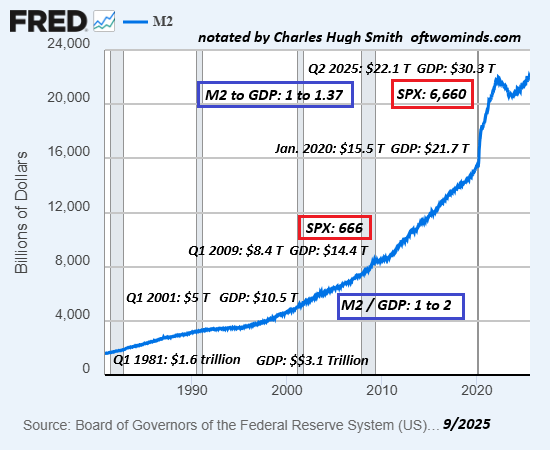
Money is funny that way. We think we understand everything about it, and so even as we predict a currency should keel over, it wins the marathon.
The point here is not to make a prediction; the point is to keep an open mind about the social-construct / utility-value of currency.
Of related interest:
Could a Rip-Your-Face-Off Rally in the Dollar Trigger a Global Financial Crisis? (October 21, 2025)
Money and Work Unchained (book)
My new book Investing In Revolution is available at a 10% discount ($18 for the paperback, $24 for the hardcover and $8.95 for the ebook edition).
Introduction (free)
Check out my updated Books and Films.
Become
a $3/month patron of my work via patreon.com
Subscribe to my Substack for free
NOTE: Contributions/subscriptions are acknowledged in the order received. Your name and email
remain confidential and will not be given to any other individual, company or agency.
| Thank you, David S, ($200), for your beyond-outrageously generous subscription to this site — I am greatly honored by your steadfast support and readership. |
Thank you, Irving W. ($7/month), for your magnificently generous subscription to this site — I am greatly honored by your support and readership. |
| Thank you, Andrew D. ($100) for your outrageously generous subscription to this site — I am greatly honored by your steadfast support and readership. |
Thank you, Meg ($7/month) for your splendidly generous subscription to this site — I am greatly honored by your support and readership. |