
This is why “knowledge is power”: those who define what is “knowable” and “known” shape the reality of everyone in the model / system.
Oh crikey, is this another boring post trying to make philosophy relevant? No, it’s a post about survival of the fittest, as what we “know” will lead us straight off the cliff in a state of delusional confidence. What we “know” is a mix of what we accept as known and what is knowable, which is defined by the system / zeitgeist / frame of reference we inhabit.
Nowadays we can’t talk about “knowing” without invoking AI, which claims to have gathered all of human knowledge and made it available to us in natural language. But as I’ve taken pains to describe this year in dozens of posts and two books, what AI presents as “known” has been processed in ways we don’t see, and these processes limit the reliability and trustworthiness of what AI presents as “known” and “knowable.”
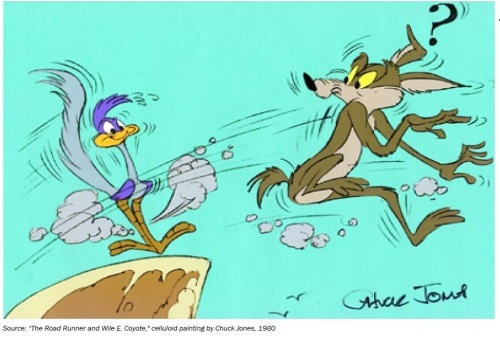
The danger here is our ill-informed confidence in AI and in what our system presents as rock-solid “knowable.” The system says Gross Domestic product (GDP) is a rock-solid measure of the economy, and since it’s rising, you can be absolutely confident about chasing gains (the Roadrunner) off the cliff. (See Wile E. Coyote below.)
Here’s the thing that gets passed over: AI hallucinates, but it doesn’t “know” it’s hallucinating; it presents fabrications as “known facts.” AI didn’t “knowingly” take digital Ayahuasca and LSD and “know” it will be hallucinating as a result. It “thinks” it’s reporting what are established “knowns”–first, this is knowable, and second, this is known.
We’re no different when we’re fed hallucinations as if they’re “known facts.” We’re unaware they’re hallucinations, and so we blithely walk off the cliff because we placed our confidence in fabrications, models that have collapsed without us being aware that 1) we accepted a model as reality and 2) the model collapsed and is now generating “information” that isn’t entirely knowable and isn’t “fact.”
You see the difference: when we knowingly take hallucinogens such as Ayahuasca or LSD, we know our experiences no longer reflect “facts.” We understand our experiences may veer into territory that science defines as “unknowable,” yet we are experiencing it anyway. We know it is unwise to walk along a cliff edge at dusk in a hallucinogenic state.
But in model collapses, we think the hallucination is the real world. It is in this confused state that we place our confidence in a hallucination and walk calmly off the cliff to our demise.
This is where the survival of the fittest kicks in: confusing reality and a model-collapse hallucination does not generate positive survival outcomes. I explain the systemic sources of this confusion in my latest book Investing In Revolution.
As I explained in Model Collapse: The Entire Bubble Economy Is a Hallucination, model collapse is the inevitable result when those controlling the model’s gearing / programming begin using the output of their previous results (output) to “train” the next iteration of their “knowledge,” i.e. what they consider knowable and known.
Using probabilistic functions and overweighting what is accepted by conventions as knowable and known both skew the outputs, which accumulate as each iteration “trains” on the skewed outputs. Knowledge that is on the margins or discounted by conventional definitions of what is being measured as “facts” is edited out of the knowledge base or reframed in conventional terms: in AI “training,” this is the Silicon Valley frame of reference.
Those who control the gearing / programming trust their own judgement and models, and so they resist recognizing the increasingly hallucinogenic nature of their model. Their frame of reference is we have god-like powers and are building utopia, and the idea that they have a poor grasp of what is knowable and what is known doesn’t penetrate their hubris.
The inhabitants of their Mouse Utopia have been trained to trust their techno-leaders as demi-gods because “technology is Progress,” and so their core survival skills–skepticism, a keen awareness of what is unknown because reality has one foot in what is intrinsically unknowable–have atrophied. Surrounded by novelties, addictive distractions, conveniences and comforts, they have lost the ability to differentiate the real world from a (highly profitable) artificial world.
This is a visual representation of what happens when a system “trains” on its own output: GDP is rising, so everyone’s doing great, money solves all problems, except moral decay and the other sources of our hallucinations, and so on:

Here’s a list of the model-collapse hallucinations we now trust as reality to our future detriment:
1. The entire global financial system is a hallucination generated by model collapse. This hallucination is most easily visible in bubbles, credit, “banking” and “money.”
2. The entire AI bubble, including AGI (artificial general intelligence), is a hallucination generated by model collapse that is being purposefully obscured to maximize private gains from the public’s embrace of the AI-bubble hallucination.
3. Social Media is a hallucination generated by model collapse that is being purposefully obscured to maximize private gains from the public’s addiction to the social-media hallucination.
4. The entire status quo of Ultra-Processed Life is a model collapse hallucination, including the delusions that all our problems can be resolved with an “abundance of money” and “energy.”
This is why “knowledge is power”: those who define what is “knowable” and “known” shape the reality of everyone in the model / system. The result is we’re living in a Mouse Utopia that is in late-stage model collapse that is largely unrecognized by the inhabitants but acutely visible to those keeping it glued together long enough to amass private fortunes before it all implodes.
It’s highly profitable to maintain the illusion that these hallucinations are “the known world,” but when the model implodes, you’ll want to be outside the ruins rather than buried beneath rubble. It is only then that we’ll realize that what we “know” is more dangerous than the unknown.
My new book Investing In Revolution is available at a 10% discount ($18 for the paperback, $24 for the hardcover and $8.95 for the ebook edition).
Introduction (free)
Check out my updated Books and Films.
Become
a $3/month patron of my work via patreon.com
Subscribe to my Substack for free
NOTE: Contributions/subscriptions are acknowledged in the order received. Your name and email
remain confidential and will not be given to any other individual, company or agency.
| Thank you, Scott B. ($7/month), for your monumentally generous subscription to this site — I am greatly honored by your support and readership. |
Thank you, Christian M. ($7/month), for your marvelously generous subscription to this site — I am greatly honored by your support and readership. |
| Thank you, Philip T. ($32.50) for your superbly generous subscription to this site — I am greatly honored by your support and readership. |
Thank you, Robert O. ($7/month), for your splendidly generous subscription to this site — I am greatly honored by your support and readership. |